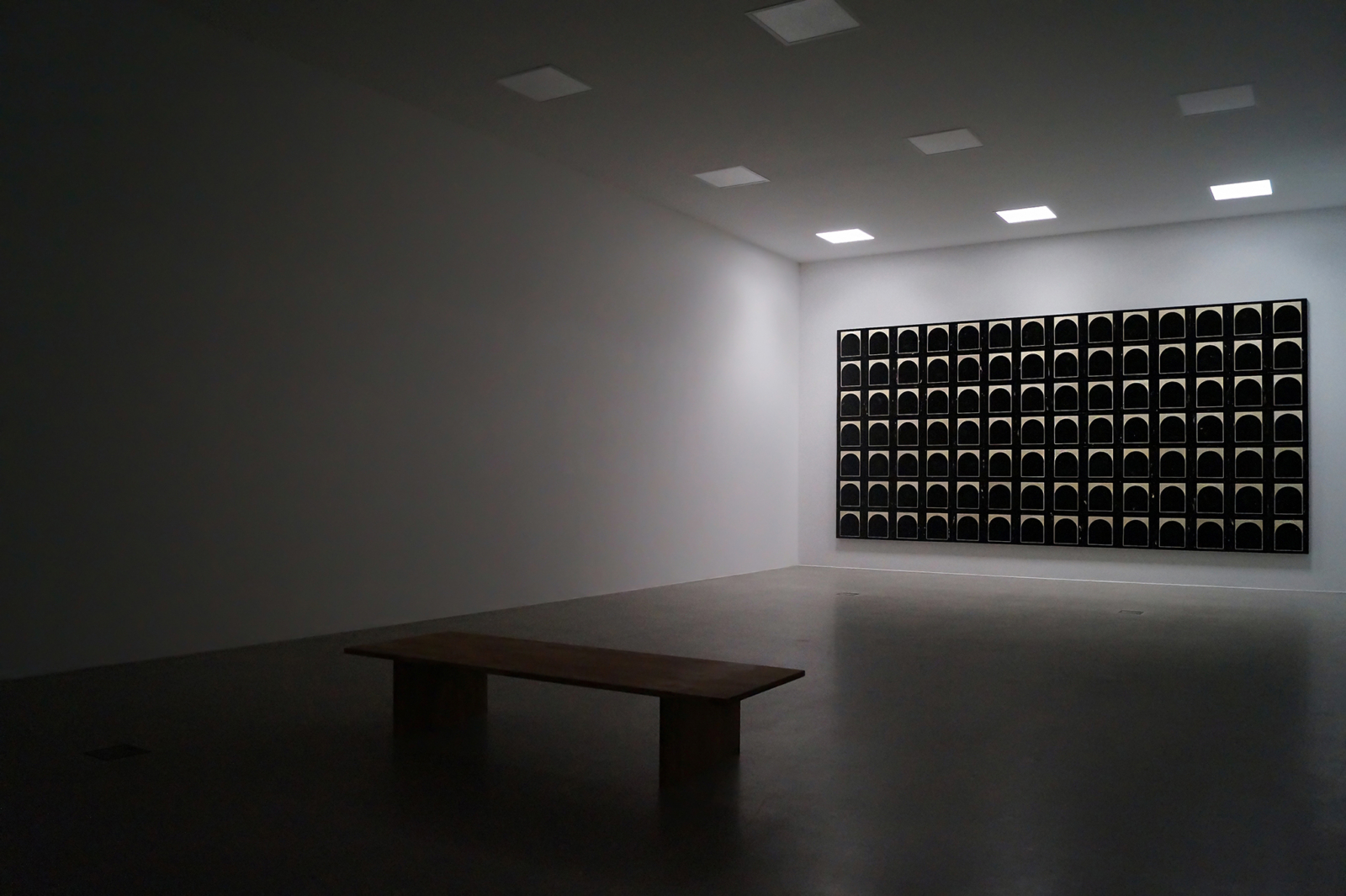
Blind Spot.1/100, Acrylic, gesso, gelatine, wooden boards, lacquer, 40 × 40 × 5 cm (X100), 2025
The exhibition Black Wall evokes a psychological state of tension experienced by the viewer who sees only their own blurred reflection, an atmosphere of expectation, uncertainty, and emptiness. A mirrored yet murky surface. The reflection is present, but it does not yield a clear image. It evokes the
same cognitive discomfort we experience in the chaos of information. The “numerical screen” of the media, infographics and death counters turns grief into abstraction. The glossy surface acts as a “screen” onto which the imagination projects its own information. There is no concrete body. A number doesn’t smell like blood, doesn’t cry, doesn’t decay. The “icon panel” is stripped of the image of suffering. Instead of a wound, there is emptiness. This uncertainty creates internal stress, a psychological equivalent of anxiety, when danger is present, but the threat never materializes. We have a series of tensions: wars, instability.
The series Blind Spot 2.1.–2.100. consists of 100 panels. This repetition and desacralization are an important part of the statement. Like news bulletins about new fronts and crises: the sheer number overwhelms, turning tragedy into background noise. The sacred format is transferred into a secular narrative. We expect consolation but receive only the horizontal plane of statistics and emptiness, hence the sensation of a “world abandoned by God.” Identical panels act as a visualized “casualty report”: anonymous, almost statistical. Their quantity and monotony transform silent horror into a mass, endless repetition of violence. The “mute scream” of the works emphasizes horror without an object. An iconostasis without icons visualizes the very structure of modern tension: the endless replication of traumatic events, the loss of the image of truth. Faced with condensed emptiness, the
viewer is simultaneously under pressure, each sees only their own reflection, but collectively we share the same dark side of our world. The rhythm of repetition resembles liturgy, but the prayer is addressed not to God, but to the void, dramatizing the sense of abandonment. As a result, repetition exposes the method of statistics while simultaneously breaking through its numbing effect. Numbers don’t allow us to feel tragedy. Psychic
numbing: the more victims there are, the weaker the emotional response, the brain shields itself from overload. The panels multiply, but the feeling remains at zero: the viewer realizes that a hundred feels the same as one.
All panels seem the same, individuality is erased, leaving an impersonal “single case.” This is how statistics work: methodologically, it “levels” the difference between lives for the sake of strict accounting. In this work, I chose rhythm over narrative. In an icon, there is a central event. Here, instead of an event—there is rhythm. Instead of a single sacred narrative, I propose a layered system. A reference to the icon-painting tradition, a sacred context. A clean, reflective surface gathers reflections of people, benches, the hall—reality is assembled from multiple fragments. An icon usually contains a revelation, but here there is only reflection, in which each person sees themselves.
The space is cathedral-like and oppressive: long “church” benches dictate the posture of the body (sitting, waiting, silence), while the number of identical panels exerts pressure. The benches create a ritual of waiting and co-presence. In a church, their function is to unite the congregation in prayer; here, to gather viewers in shared silence, the horror of war as a collective but unspoken experience. The mirrored emptiness emphasizes that behind every number is a face, yet we see only our own reflection—a sign of personal responsibility for someone else's “invisibility.” This work is not about numbers, but about how numbers kill feeling. Through repetition, you intensify the numbness to the point of loud, almost physical pressure, forcing the viewer to perceive the scale of the tragedy precisely through its apparent imperceptibility.


